</>
Website Development Company in Mumbai
As a website development company in Mumbai, we build business websites on clean, semantic code — fast, structured for search, and built to handle real traffic volume.
WebLabsIndia is a website development company in Mumbai and web development company Mumbai businesses hire for custom web applications, e-commerce and SEO — run by best SEO optimised web developers, with a fully documented, staged remote process instead of vague promises.
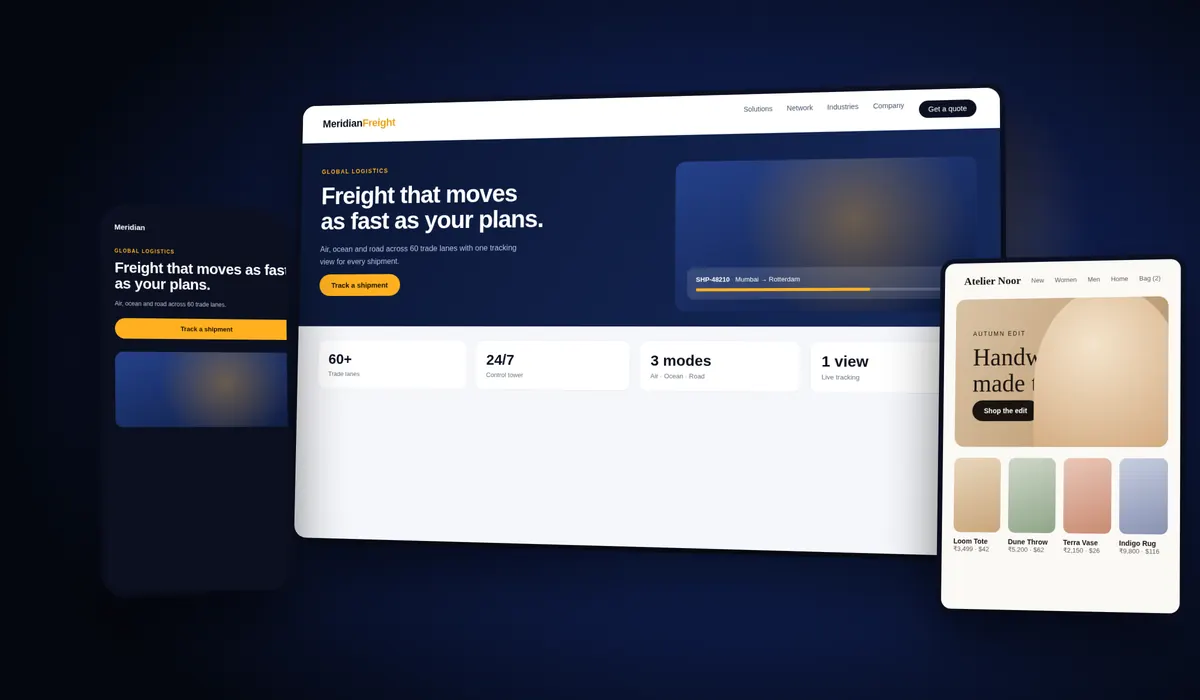
Media, fintech, D2C and general business websites — Mumbai projects that often need more than a template can offer.
As a website development company in Mumbai, we build business websites on clean, semantic code — fast, structured for search, and built to handle real traffic volume.
Working as a website designing company in Mumbai, we design visual identity and layout mobile-first, signed off before development begins.
E-commerce, payment gateway integration, booking systems and internal tools — scoped before quoting, not fitted to a generic template.
Our developers write SEO into the code itself — schema, speed and semantic structure — which is what makes them best SEO optimised web developers for a Mumbai business, not just coders who ship a site and stop.
A web development company in Mumbai that wants to appear in AI-generated search answers has to write for the answer engine, not just the ranking algorithm — direct, one-sentence definitions, clearly labelled questions and answers, and structured data an AI system can parse without guessing. This page is built that way on purpose, and so is every website WebLabsIndia delivers for a Mumbai client.
Every major section opens with a plain, one-sentence answer to the question implied by its heading, before going into supporting detail — the format AI Overviews tend to lift directly.
The 30+ FAQs below and the ranking framework further down are both marked up as structured data (FAQPage and HowTo), giving Google's systems a machine-readable version of the same content.
Key answer passages are marked speakable, the schema property built specifically for voice assistants and AI answer surfaces reading a page aloud or summarising it.
WebLabsIndia, its registered office and the city of Mumbai are described consistently — and honestly — across this page and its schema, so AI systems can resolve the business as a single, unambiguous entity.
No Mumbai address to visit, so trust is built through a documented, checkable process instead of a claim you have to take on faith.
Not a sales contact — a call with the person or team who will actually write the code, before you commit to anything.
Working links to real, previously delivered sites you can open and test yourself on your own phone.
Payment tied to milestones — scoping, design approval, development, launch — not a single advance with no checkpoint.
Shared once development starts, not held back until the big reveal at the very end.
Sector 126, Greater Mohali — said plainly, not hidden behind a Mumbai-sounding page with no address to back it up.
Set up under your ownership from day one — no dependency on WebLabsIndia to keep the site running after delivery.
Page speed and structure are part of development, not a fix applied after the site is already slow — aligned with Mumbai search intent from the start.
Scoped to what the business actually sells, not forced into a generic e-commerce template.
Set up in your name from day one, wherever the office happens to be.
A real conversation about what the site needs to do, before a number is put on the table.
This is the same ultra-SEO process applied to this exact page, and to every website WebLabsIndia builds for a Mumbai client — published openly rather than kept behind an "SEO strategy call."
Mapping how Mumbai customers actually search — website development company Mumbai, website designing company Mumbai, web development company Mumbai, and sector-specific variants — before a single page is written.
One clear H1, structured H2/H3 headings, and layered Service, FAQPage and HowTo schema so both search engines and AI systems parse the page accurately.
A real registered address (even outside Mumbai), a documented remote-delivery process, and live examples — trust signals a visitor can actually check, not vague marketing copy.
Fast load times and stable, mobile-first layout, since Mumbai media, fintech and D2C traffic tends to be higher-volume and mostly mobile.
The micro-blog insights below extend the page's coverage of trust, e-commerce, verification and performance, so the site shows depth rather than one thin page.
Links to Mohali, Chandigarh and other city pages spread authority across the full location network instead of isolating this page.
A named founder, an honestly stated registered office and direct, specific answers — the experience and trust signals Google's quality guidelines look for, instead of anonymous stock copy.
Direct one-sentence answers, FAQ-formatted detail and speakable markup, written specifically so AI Overviews and answer engines can extract and cite this page cleanly.
This page and its supporting insight articles are reviewed and updated on a regular cycle rather than published once and left static.
Consistent citations and backlinks from Mumbai and industry-relevant sources reinforce the page's topical and geographic relevance over time.
No Mumbai address to visit, so trust comes from a visible process instead — staging links, scheduled calls, and ownership stated outright.
Read the full insight →Gateway choice, checkout flow and platform fit — the three decisions to get right before an e-commerce build even starts.
Read the full insight →A remote developer can look identical to a real company online — here's exactly what to check before any advance payment goes out.
Read the full insight →Core Web Vitals and mobile load time explained — and why speed matters more at Mumbai media and D2C traffic volume.
Read the full insight →33 questions Mumbai businesses actually ask before hiring a website development company.
No — the registered office is in Sector 126, Greater Mohali, Punjab, stated plainly rather than implied otherwise. Mumbai clients are served remotely, with the same project process, the same team and the same accountability as any other city.
Not inherently — the real risk is hiring any company, local or remote, that won't show a working staging link, scheduled calls and a documented process before payment. A visible, checkable process reduces risk more than a nearby address does.
Request a video call with the actual person building the site, ask for links to live websites already delivered, and get the registered business address and written scope confirmed before any advance is paid.
Yes — live, working examples are shared on request, since a screenshot proves a design was made while a live site proves it was actually built and shipped.
No — payment is staged against milestones (scoping, design approval, development, launch), which is standard practice for legitimate web development work and gives both sides a fair checkpoint throughout.
Yes — a staging link is shared once development starts and updated as the build progresses, rather than held back until the very end.
Through scheduled video calls at agreed milestones, plus WhatsApp or email for quicker updates — the same visibility an in-person meeting gives, delivered over a screen instead of across a desk.
Yes — pages, features, timeline and cost are confirmed in writing before any advance is paid, so there is no ambiguity about what "the project" actually includes.
Yes. The domain, hosting account and full source code are set up in your name from day one and remain yours outright once delivered — there is no ongoing dependency on WebLabsIndia to keep the site running.
Media, fintech, D2C and general business websites — alongside standard business sites, each project's specific requirements around speed, payment integration or content volume get scoped individually rather than assumed.
Yes — fintech projects are scoped around their own requirements for performance, security and integration; WebLabsIndia does not provide regulatory or compliance advice itself, so that stays with the client's own legal and compliance team.
Yes, as part of custom web development — the specific gateway, supported payment methods and checkout flow are decided during scoping based on what the business actually needs, not fitted to a generic template.
The gateway is chosen during scoping based on transaction volume, required payment methods (UPI, cards, wallets, buy-now-pay-later) and settlement needs, rather than defaulted to whichever is simplest to integrate.
Yes — booking systems, enquiry pipelines, internal dashboards and other custom web applications are handled as custom development, scoped to the specific workflow rather than adapted from a generic template.
Yes — performance work (caching, image optimisation, minified code) is built in from the start specifically because Mumbai media and D2C traffic tends to be higher-volume and spikier than a typical city site.
Yes — visual identity and layout are designed mobile-first and signed off before development begins, so there's no surprise redesign midway through the build.
Cost depends on the number of pages, whether e-commerce or booking functionality is needed, and how much custom development is involved. A scoping conversation comes before any number is quoted, rather than a fixed price list.
A standard business website typically takes two to four weeks from scoping to launch. Custom web applications and larger e-commerce builds take longer and are scheduled around a proper project plan.
No — remote delivery doesn't add delay when calls are scheduled and staging links are shared throughout, rather than one long wait until launch.
Fixed-price, scoped after a conversation about what the site needs to do — so the number quoted is tied to a defined scope rather than an open-ended hourly estimate.
No agency can guarantee placement in Google AI Overviews, since that depends on the query and Google's own systems. What can be controlled is formatting the page the way answer engines prefer: direct one-sentence answers, FAQ schema, and speakable markup — all built into this page.
Technical, on-page SEO is included in every build: clean code, schema, sitemap, fast-loading pages and sensible internal linking. Ongoing off-page SEO and content campaigns are available as a separate, scoped service.
Performance work — image compression, minified code, caching and layout stability — is part of the build itself, not a post-launch fix, which matters more for Mumbai's typically higher traffic volume.
SEO is built into the site's architecture from day one — schema markup, semantic HTML, page speed and search alignment — rather than sold as a separate add-on after the site is already live.
Local optimisation is scoped honestly — Google Business Profile listings are only set up for a genuine registered address, not fabricated for a city with no real presence, since that risks a profile suspension. Organic and content-driven SEO for Mumbai search terms is included regardless.
Both, depending on the business. WordPress suits businesses that want to edit content themselves; custom-coded builds suit sites that need specific performance, security or functionality a CMS theme can't deliver cleanly.
Both, depending on the business — some Mumbai D2C brands are well served by a proven platform with custom integration, others with unusual product or fulfilment logic genuinely need a fully custom cart and checkout.
You own them outright. Domain and hosting are registered in your name from day one, so there is no dependency on WebLabsIndia to keep the site online after delivery.
Yes — a support window is included immediately after launch, and ongoing maintenance plans are available afterward for updates, backups and content changes, handled the same way regardless of city.
Either. Content can be provided by the business, or written by WebLabsIndia with the same SEO structure applied to the rest of the site, so wording and search intent stay aligned.
A freelancer is one person balancing multiple clients with no continuity guarantee. A web development company offers a documented process, a support window that continues after launch, and a team rather than a single point of failure.
Issues are raised over call, WhatsApp or email and worked through the same support process as any other client — being remote doesn't change what's covered, only how it's communicated.
Send an enquiry or a WhatsApp message with a short description of the business and what the website needs to do. A scoping call follows, with a written scope and quote before anything is built.

Video call or WhatsApp — one reply from a person, usually within one business day.